
Monday, December 3, 2012

Sunday, April 1, 2012

Wednesday, March 28, 2012
Ascot Tie
What is an Ascot?
Traditionally an Ascot cravat was only worn with morning dress. The name originates from the famous Ascot horse races where dressing up in your finest was order of the day. Today the Ascot has evolved into a stylish, but far less formal form of neck-wear. Less formal even than a traditional neck tie, but still formal enough to still be called a tie. An Ascot is made, tied and worn in similar ways to the more conventional necktie, but with enough differences to make it uniquely special.
Traditionally an Ascot cravat was only worn with morning dress. The name originates from the famous Ascot horse races where dressing up in your finest was order of the day. Today the Ascot has evolved into a stylish, but far less formal form of neck-wear. Less formal even than a traditional neck tie, but still formal enough to still be called a tie. An Ascot is made, tied and worn in similar ways to the more conventional necktie, but with enough differences to make it uniquely special.
 Remember how a few years ago the only people who wore bow ties were those who wanted to be a bit different, but today bow ties are very much in the mainstream? If you are looking to make an impact and stand out today, you don’t choose a bow tie, you choose an Ascot. You can dress up your smart-casual/business-casual work wear. You can also dress up your casual clothes and denim. An Ascot is a really versatile addition to your wardrobe. If that wasn’t enough, if you choose carefully, you can even find reversible Ascots to double your opportunities to wear them.
How to wear an Ascot.
For casual wear you can smarten up your denim jeans by wearing a dress shirt and sport coat. If however, you add an Ascot, you will lift the style to a level befitting a modern gentleman. This look is great for classy day wear and stylish evenings out.
For casual wear you can smarten up your denim jeans by wearing a dress shirt and sport coat. If however, you add an Ascot, you will lift the style to a level befitting a modern gentleman. This look is great for classy day wear and stylish evenings out.
 For a different look at work, many offices are loosing the suit jacket and neck tie, having the shirt open. By adding an Ascot here it will keep you smart, but will add a dash of stylish fun. It’s a very continental look that takes confidence to wear, but is rewarding for those who are looking to be a bit different without resorting to a bow tie which in my opinion are becoming far too common to be different.
Tuesday, March 27, 2012
An excerpt from and interview with Brunello cocinelli by Permanent Style
From the Brunello Cucinelli Spring/Summer 2012 catalogue: “The color palette features pastel shades with slightly grayish, faded, and mélange tones: Lily, Plum, Chamomile, Geranium, Lime, Mint, Quartz, Antarctic White, Coral, Orange, and Eucalyptus”
Permanent Style: Thank you for talking to us from Solomeo, Brunello.
I’d like to ask you about your use of colour in your collections, if I may, particularly for Spring and Summer. Your clothes frequently use pale colours for this season, and I think this is something English men are traditionally bad at wearing during the summer months, tending to extremes of pale linen and nothing else. What is the key to wearing pale colours well?
Brunello Cucinelli: I think the key is to always match a colour with something neutral. So you could wear a nice pale orange trouser, but with a mid-grey or navy jacket. Or, if the weather suits pale colours everywhere, make sure one of them is a neutral colour like a beige or a cream.
The collection is organised along these lines, and it’s not too much to say that it is the philosophy of the company to present things in this way.
Permanent Style: Thank you for talking to us from Solomeo, Brunello.
I’d like to ask you about your use of colour in your collections, if I may, particularly for Spring and Summer. Your clothes frequently use pale colours for this season, and I think this is something English men are traditionally bad at wearing during the summer months, tending to extremes of pale linen and nothing else. What is the key to wearing pale colours well?
Brunello Cucinelli: I think the key is to always match a colour with something neutral. So you could wear a nice pale orange trouser, but with a mid-grey or navy jacket. Or, if the weather suits pale colours everywhere, make sure one of them is a neutral colour like a beige or a cream.
The collection is organised along these lines, and it’s not too much to say that it is the philosophy of the company to present things in this way.
Friday, February 24, 2012
Canvas Fully Floating Jacket
Fused or Canvas
Fully floating canvas
The point that started the discussion on quality came from explaining what is commonly referred to as the pinch test to see if a jacket is canvassed or fused. The test is to see if the coat has a lining that has been glued (or fused) to the inside of the jacket or if it is a structure in it’s own right (canvassed). I know I said in the opening statement that there is no single thing that makes a suit a quality garment, but having a fully floating canvassed jacket is probably the strongest indicator of quality there is. OK so what does all that actually mean and what is this pinch test?
Traditionally, suits are constructed by creating an inner frame work made from horse hair or a combination of wool/mohair called a canvas, the outer fabric is then attached to it by hand stitiching. The canvas was there to provide structure to the coat, and so is made from a much stiffer fabric. Over time the stiffer canvas moulds to your shape providing a perfect fit, this allows the exterior panels to hang naturally. This method is labour intensive and not suited to mass produced, high volume sales suits. All this ads up to a great indicator of a quality suit.
Te Polo Coat
History of The Polo Coat
Originating in England, the Polo coat refers to the loose-fitting, casual style of overcoat that was originally worn by polo players in between chukkers – hence it became known as the Polo Coat or Wait Coat. Originally, a polo coat was made out of camel’s hair and was designed as a wrap coat. Instead of buttons, it simply featured a belt.
Before WWI, polo arrived in the US and when players wore their coats after games, the polo coat was adopted by spectators and fashion leaders alike. In 1926, the camel hair coat became particularly popular with college kids in Princeton and Yale, and a few seasons later, it had conquered the United States entirely. By the late 1920s, almost any Ivy League undergrad counted a Chesterfield as well as a Polo Coat wardrobe staples.

Polo Coat With Spectators
In December 1928, the famous Men’s Wear magazine remarked: ” While the vogue of this style [Polo Coat]with the best dressed men of the world is indisputable, it is only getting started, so far as national popularity is concerned. By promoting this style for fall and next spring in the medium weight material, which is really an all year round proposition, merchants will not only increase profits, but enhance their style prestige” .

Polo Coat & Covert Coat
In November 1929, at the Yale-Princeton football game the camel hair coats worn by the spectators far outnumbered traditional raccoon overcoats, and given the sartorial importance of this event, the Polo Coat had certainly made its mark.
Overall, the polo coat was the overcoat that had the biggest impact on men’s fashion in the US between 1920-1930.

Polo Coat with inverted Pleat in the back
In the 1950s, the once-ubiquitous Polo Coat was overshadowed by the emergence of the all purpose raincoat with a detachable lining, and the subsequent loss of popularity meant that it could no longer be easily found in stores. As such, it could only be found in the wardrobe of the style-conscious men who deliberately sought to add this classic piece to their repertoire. It resurfaced again briefly in the mid 1980s, but it never became as popular as it was during the 20′s.
Polo Coat Style Features

Polo Coat 1930s

London Lounge Polo Coat in Herringbone
Unfortunately, pure camel hair fleece wears out rather quickly on hems, cuffs and collars. Therefore, Camel’s hair fabric is often blended with 50% virgin wool. You may also find blends with nylon, but these may be inferior because of the use of camel guard hair instead of fleece.Unfortunately, the Polo coat was initially worn only by polo players, and so the exclusivity of the original leaves us with little documentation of it’s true features. Once the public caught on, the belt of the wrap coat was enhanced with a button closure, and the 6 x3 double breasted model with a half belt, set-in sleeves, Ulster collarand patch pockets was considered to be the classic polo coat. As always in fashion, a number of variations evolved, among them a single-breasted camel hair coats , raglan sleeves, full belts, no belt, peaked lapels, cuffs or eight buttons instead of six. Some Polo coats also had an inverted pleat in the back. With all these modifications, the Polo Coat became very similar to the Ulster overcoat.
Camel’s Hair Fabric

Polo Coat Ralph Lauren
Camel’s hair is a woven fabric made of yarn that consists of fibers from the Bactrian camel, a special long-haired species with two humps that is native to central Asia, but is presently produced in China, Mongolia, Afghanistan, Iran, Russia, New Zealand and Australia.
The best quality of camel hair fiber is derived from the fine fleece undercoat grown under the camel’s shaggy outer coat guard hair. It is lightweight, soft and insulating as it has to protect the camel efficiently from extreme heat and cold.
Camel hair is often seen in its natural golden tan color, though on occasion you can also see it in black, charcoal or navy. Also, by the early 1930′s you would see patterned fabrics such as herringbone or windowpanes but this fashion did not last for very long.
Since Polo Coats were always made of camel’s hair, some people referred to it as Camel’s Hair Coat, which became a synonym for Polo Coat.
Saturday, January 28, 2012
HOW TO CHOOSE A SINGLE BREASTED JACKET
fashion conscious and won’t be covered here. All single breasted jackets are designed around a central button, this is to give the jacket structure to help it hang correctly, and so a jacket should always be fastened at the front. In the 3-button, the coat is designed for the top 2 buttons to be fastened normally. On a 2-button coat, you would only fasten the top button, and in the 1-button version, keep the button fastened. Wearing the jacket unbuttoned ruins the lines, and traditionally a gentleman would never remove his jacket in mixed company so when choosing a jacket, make sure you can sit comfortably with the jacket buttoned, another reason to leave the bottom button unfastened with 2 and 3 button jackets.
How many buttons? If the suit is bespoke, your tailor should ensure the jacket is in proportion so it is personal preference. If however, you are buying off the rail, 3 button jackets can shorten the length of the lapel giving a squat look on shorter men. 2 button jackets can extend the length of the lapel giving the impression of a longer body.
How many buttons? If the suit is bespoke, your tailor should ensure the jacket is in proportion so it is personal preference. If however, you are buying off the rail, 3 button jackets can shorten the length of the lapel giving a squat look on shorter men. 2 button jackets can extend the length of the lapel giving the impression of a longer body.
The Lapel
Lapel widths vary with the changing fashions, and current trends are for a thinner lapel. This is also a classic style and the safe bet for a timeless look. A thinner, longer lapel will elongate the body and enhance the illusion of height for an elegant look. Broader lapels work better when presenting an athletic build, but do not work so well on shorter frame.
Lapel Notch
The lapel notch is the part of the jacket where the collar meets the lapel. As the length of the lapel is core to the shape of the jacket, a higher notch will allow for a longer lapel giving the illusion of a longer body. Most men will look for jacket that makes them look a bit taller, so look for a notch at the clavicle or higher unless you are very tall.
Button Hole
The top of the left lapel, about an inch or so below the notch, should carry a buttonhole for a flower. Quality jackets will have a working, hand stitched buttonhole. Many modern jackets have a fake buttonhole or if it is working a machine stitched one.
Jacket Pockets
The suit jacket always carries at least three pockets. A handkerchief pocket on the left breast, which in my opinion is a waste if left unused. An exception is modern office culture where you may feel overdressed, but if you can wear a pocket handkerchief, you should.
Two side pockets either jetted or flap covered. Jetted pockets are the most formal and are usually seen on dinner jackets. Flap pockets are the standard for jackets. The flap was intended to be a functional addition to keep the contents dry from the rain, but tucked in when the wearer is indoors to resemble a jetted pocket. Now pocket flaps are part of the design and as such, may not even be able to be tucked in at all.
Variations on these traditional pockets are patch pockets which are informal and usually seen on sports jackets. Unlike traditional side pockets which have the pocket on the inside of the jacket and are accessed via a slit, the patch pocket is created by stitching a patch on the outside of the jacket.
Ticket pockets are a half or three quarter sized pocket above the right side pocket. These are designed to hold a tube ticket and are usually only found on higher quality jackets.
Hacking pockets can trace their origins to equestrian trends. Hacking pockets are when the pockets are angled, to make them accessible when riding a horse.
Two side pockets either jetted or flap covered. Jetted pockets are the most formal and are usually seen on dinner jackets. Flap pockets are the standard for jackets. The flap was intended to be a functional addition to keep the contents dry from the rain, but tucked in when the wearer is indoors to resemble a jetted pocket. Now pocket flaps are part of the design and as such, may not even be able to be tucked in at all.
Variations on these traditional pockets are patch pockets which are informal and usually seen on sports jackets. Unlike traditional side pockets which have the pocket on the inside of the jacket and are accessed via a slit, the patch pocket is created by stitching a patch on the outside of the jacket.
Ticket pockets are a half or three quarter sized pocket above the right side pocket. These are designed to hold a tube ticket and are usually only found on higher quality jackets.
Hacking pockets can trace their origins to equestrian trends. Hacking pockets are when the pockets are angled, to make them accessible when riding a horse.
Jacket Vents
The vent is the slit up the back of the jacket. A single vent is the traditional style and is another equestrian detail. The wearer could ride on horseback and still allow the jacket to hang correctly. Modern times have introduced double vented jackets so the modern gentleman can place his hands in his pockets without his jacket parting at the rear to expose the seat of his pants and keeping his modesty.
Jacket Length
A well-fitting jacket is just long enough to allow the wearers fingers to curl around the bottom edge when standing straight. Any shorter will expose the seat of the pants, any longer and the elegance will be lost. Ideally you will be able to pinch the bottom edge of the jacket without moving the angle of your wrist.
Jacket Sleeves
Often off-the-rail suits have the sleeves cut far too long. A good fitting sleeve will show approximately 1/4 to 1/2 inch of shirt cuff and will stop in line with the wrist joint. There should be 4 working buttons at the end of the sleeve which are perfectly aligned and have minimal spacing. Traditionally to enable the wearer to wash his hands with removing his jacket, today working sleeve buttons are a sign of a quality garment.
Thursday, January 5, 2012
Berluti Shoes. What a design!
I don't know what I love more, the actual picture (the outfit, socks, pants, shoes, the shot etc.) or just the shoes themselves? This has to be one of the coolest, if not, the coolest picture I have ever seen regarding shoes. The perfectly cropped pants, just enough to show those purple socks, paired with these shoes that almost look unreal, yet in reality, are perfect pieces of art with a patina to die for! While I do like Berluti, for their magnificent looks, I have to say that in person they always look a little frail to me, like I would be afraid to wear them for fear of truly ruining them, even though I prance around avoiding everything and anything that could harm my shoes: puddles, grass, dirt etc. Nevertheless, I do love this shoe and also love this picture and have to say that even though I probably wouldn't wear the outfit he has on, I admire the fact that this person was wearing it!!

Wednesday, January 4, 2012
How to wear brown shoes
I am surprised how frequently the questions I am asked centre around one object of clothing: brown shoes. This is because men’s certainty about the alternative (black shoes) creates a spectrum of worries as to how, when and where they should be worn.
It’s really not that difficult.
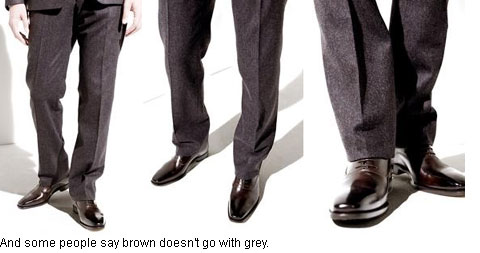
First, forget all that ‘never brown in town’ rubbish. Do you wear a dark suit to work everyday (usually a three-piece), keep the jacket on throughout and always pair it with a sober tie? Then you’re breaking far more recent rules than the brown/town one – which was established when brown was a sure sign that a man was loping off to his country estate after work.
Modern business attire is far more flexible. Understand the spirit of archaic rules, rather than blindly following the letter.
Second, black shoes are an English thing. Yes they mean business everywhere, but other countries (Italy, US) accepted the benefits of brown leather years ago. You wear an Armani suit and a Ralph Lauren shirt. Why stick obstinately to an English tradition?
So, what to wear them with? Navy and mid-grey are my favourites. Avoid lighter blues and darker greys (charcoal). There is no particular rationale for this, but those tones benefit in particular from having a colour in the shoe they are worn with. Black is not a colour; it may serve to enrich the colour it is worn with, but it is not a colour itself.
Those are some basic cloth suggestions. The important thing to remember is that the same guidelines on shoes elsewhere also apply to brown – indeed if anything they are more important there.
One is that your shoes should always be darker than your suit trousers. If tan shoes are being worn more casually, there is some leeway there. But don’t wear tan shoes with a navy suit. Try a chocolate brown instead and you’ll realise what the Italians are going on about – why they embolden each other.
(I have seen several men in recent days actually wearing black suits with tan shoes. I only hope that has happened through a lack of thought. How someone could think those two would complement each other is beyond me.)
A second guideline to bear in mind is that brown shoes are still not as smart as black. Yes, they are accepted; but no, they are not a replacement. If you’re in doubt about what to wear to a meeting, wear black. If you’re in doubt what to wear with odd trousers, wear brown. Use your judgement and aesthetic nouse for everything in between.
Some people still dislike brown shoes for being inelegant. Part of the reason I like them so much is probably the greater possibilities for patina and polish. Whatever your reason, think through their use logically using these guidelines and you can’t go wrong.
First, forget all that ‘never brown in town’ rubbish. Do you wear a dark suit to work everyday (usually a three-piece), keep the jacket on throughout and always pair it with a sober tie? Then you’re breaking far more recent rules than the brown/town one – which was established when brown was a sure sign that a man was loping off to his country estate after work.
Modern business attire is far more flexible. Understand the spirit of archaic rules, rather than blindly following the letter.
Second, black shoes are an English thing. Yes they mean business everywhere, but other countries (Italy, US) accepted the benefits of brown leather years ago. You wear an Armani suit and a Ralph Lauren shirt. Why stick obstinately to an English tradition?
So, what to wear them with? Navy and mid-grey are my favourites. Avoid lighter blues and darker greys (charcoal). There is no particular rationale for this, but those tones benefit in particular from having a colour in the shoe they are worn with. Black is not a colour; it may serve to enrich the colour it is worn with, but it is not a colour itself.
Those are some basic cloth suggestions. The important thing to remember is that the same guidelines on shoes elsewhere also apply to brown – indeed if anything they are more important there.
One is that your shoes should always be darker than your suit trousers. If tan shoes are being worn more casually, there is some leeway there. But don’t wear tan shoes with a navy suit. Try a chocolate brown instead and you’ll realise what the Italians are going on about – why they embolden each other.
(I have seen several men in recent days actually wearing black suits with tan shoes. I only hope that has happened through a lack of thought. How someone could think those two would complement each other is beyond me.)
A second guideline to bear in mind is that brown shoes are still not as smart as black. Yes, they are accepted; but no, they are not a replacement. If you’re in doubt about what to wear to a meeting, wear black. If you’re in doubt what to wear with odd trousers, wear brown. Use your judgement and aesthetic nouse for everything in between.
Some people still dislike brown shoes for being inelegant. Part of the reason I like them so much is probably the greater possibilities for patina and polish. Whatever your reason, think through their use logically using these guidelines and you can’t go wrong.
Subscribe to:
Posts (Atom)