Sunday, December 25, 2011

How to get a ready-to-wear suit altered

Go To Ahmed's Tailor and Bespoke Suits :)

basic_suits

You don’t need to go bespoke, or even made-to-measure, to get a suit that fits well. Most quality stores that sell suits will offer alterations at a decent price. At Ralph Lauren, for example, the policy is to do alterations at cost; the store makes no money off it. This service won’t necessarily be advertised, so ask.
The key to getting a well-fitting suit off the peg, therefore, has two elements: buying the right size, and getting it altered. To buy the right size– look at the suit’s collar and its shoulders.
Pretty much everything can be altered in a suit except the shoulders. Obviously the jacket cannot be lengthened; but the sleeves can be lengthened or shortened, the waist taken in or let out (both trouser and jacket), the crotch taken out/in and the trouser legs lengthened/shortened.
So when you try on a ready-to-wear suit, look at the back of your neck (in a mirror) and the shoulders. The back of the suit should neither stand away from your neck, nor wrinkle up and create a little ridge behind the collar. The first shows the cloth has too much slack, the second that it has too little.


Then take the suit to the in-house tailor (or an external one if you have had it recommended). The trousers will be relatively simple to alter – you’ll know what feels comfortable around the waist, as is pinned or examined by the tailor, and what you prefer on the length. The safest option on length is one break in the front crease of the trouser, none in the back.
The first things to have altered on the jacket are the waist and the arms. The fit of the waist is very much a matter of personal taste, but there should be an obvious suppression in the line of suit at your side, going in where your waist button fastens (middle button on a three-button suit, top one on a two-button). There should be no folds radiating from the waist button, which again show the cloth being stretched. And when you pull the waist button away from you, it should pull out easily an inch or two, but no more.
If the chest or hips of the jacket are also a little big, make sure the suppression the tailor makes at the waist has a long tail, finishing high up around the chest and low down the vents.
Lastly, sleeves. Suits are generally manufactured with longer arms than average because few men notice that their sleeves are too long. They’d notice if they were too short, as there would be a startling excess of cuff. But an inch or two too long goes unnoticed.

Monday, December 19, 2011

Lorenzo Cifonelli

Lorenzo Cifonelli's constant innovation in his menswear designs. Some I like more than others, but I love the embroidery of the Japanese symbol for love on the lapel of this grey jacket. I'd go for a bit of subtle embroidery on a sports jacket. Lorenzo, though, says this piece is intended to be a sharp, sexy piece for the evening. The slim peaked lapels and one button certainly lean that way.


Wednesday, December 14, 2011

here are people who like to picnic


May 1933. "Mr Fellows can draw people on picnics as often as he likes. The only thing we resent is when he draws men looking happy on picnics. Nor will we refuse to pass along the word, furnished by our fashion scouts, that picnicking is on the increase as a social pastime. We do reserve the right to report it with the exact degree of enthusiasm with which we should report an increase in cholera. Anyway, this is supposed to be about the clothes.

The man on the left wears a cheviot tweed jacket with slanting pockets and side vents, in a small checked pattern that is popular now in unusual colourings. The Saxony flannel trousers match the colour combination, but not the pattern, of the jacket. A knitted cardigan, a flannel shirt, bow tie, blucher suede shoes and pork pie hat complete the outfit.

On the right is a tweed knicker suit worn with a cable-stitch sweater, monk-front shoes and a shepherd check cap."

I think I'd like a tweed jacket with a small checked pattern in an unusual colouring. What do you reckon? Purple?

Thursday, December 8, 2011

Week-end wardrobe for travelling light - Esquire, July 1936


Esquire, July 1936: "For a quick trip involving both town and country or resort appearances, where luggage must be kept down to little better than a briefcase, the answer is a pair of white or grey flannel slacks plus the outfit pictured here. These clothes look normal enough for informal town wear and still go very well against a rural or resort background. 

The suit is grey flannel with red stripes, a combination of colour and fabric that has been accorded market popularity in London. It is made in a two-button single breasted peaked lapel model with welt (that is, unflapped) pockets. 

Wednesday, December 7, 2011

British bespoke - Part 6

6bb1
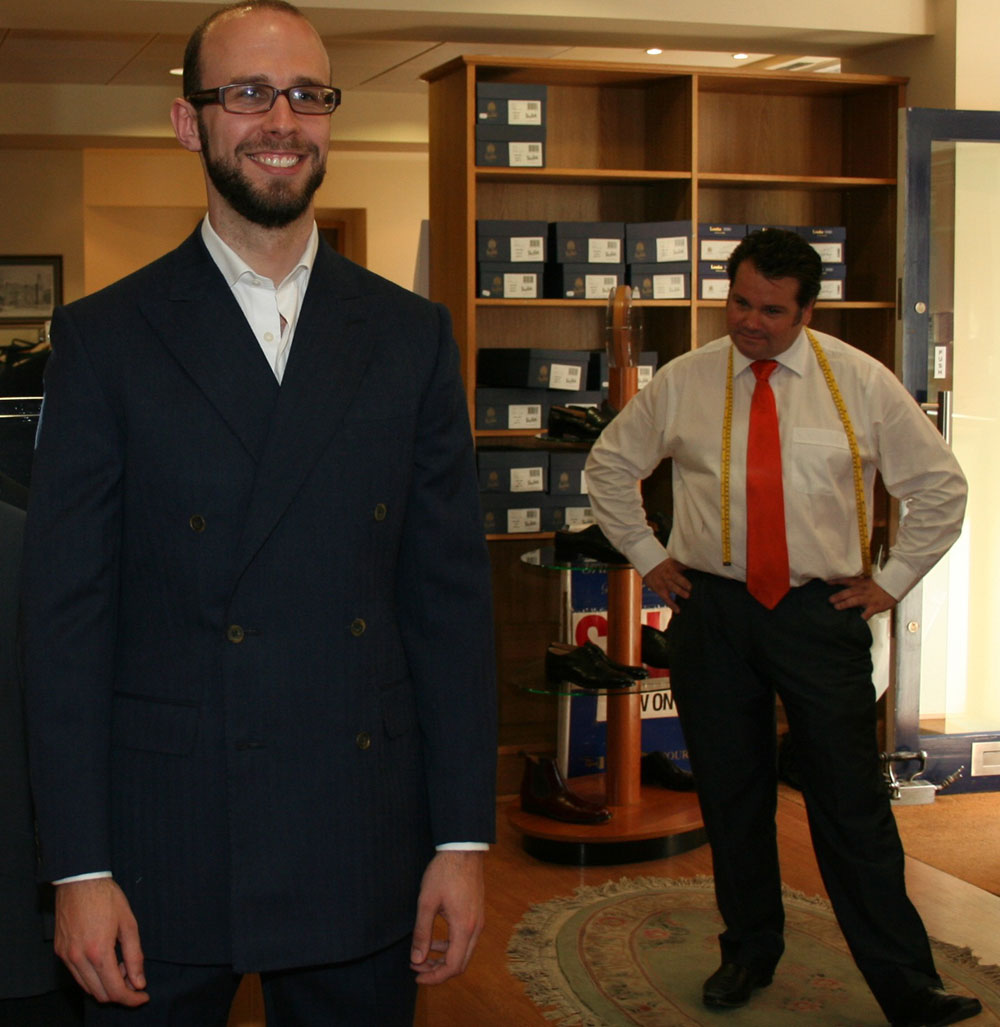
At last. The suit is ready and my first bespoke experience in the UK is almost over. The blue double-breasted piece, in a small herringbone with brown-detail buttons, has been seven weeks in the making. But now it’s ready to take away.
I timed my visit to Graham Browne so I could actually see the final touches – largely, the sewing on of the buttons. This is something I particularly wanted tips on, because I’ve done it myself and, while the buttons haven’t fallen off, they never look quite right.
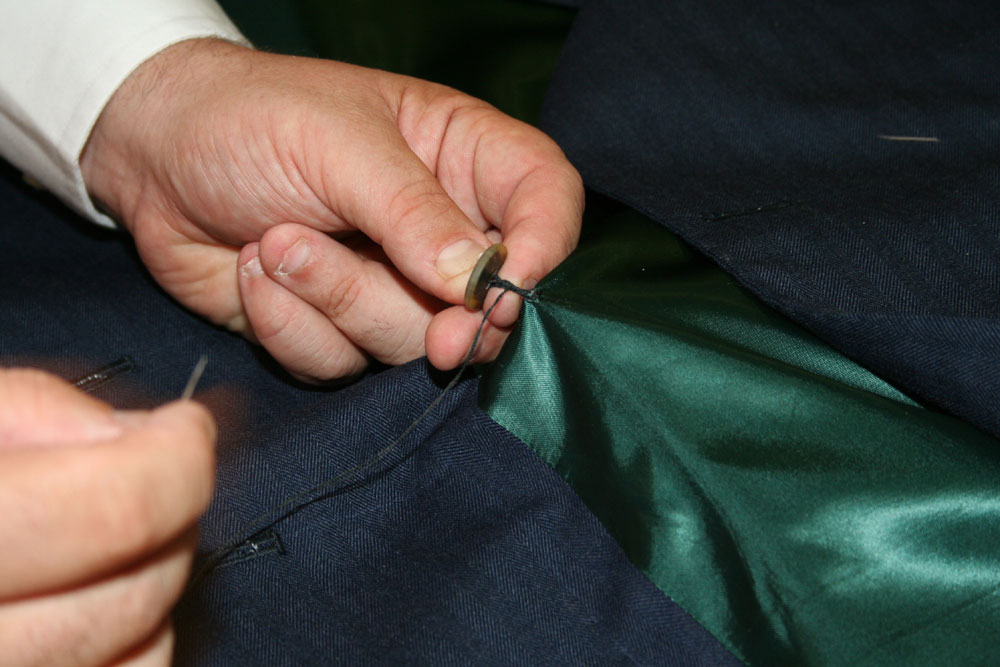
A tailor will use slightly thicker thread than normal, doubled up and waxed. Indeed, at one point Russell added more wax to the thread by drawing it through a little lump of the stuff.
The thread should be knotted at one end and pulled through both the cloth and its lining. Some people apparently like the knot to go all the way through, so you can see a dimple on the other side. But to me this looks like the sewing was done by, well, me. To make sure the needle goes this far through and no further, Russell puts a ruler inside – so that bumping up against this means you have gone far enough, but you can’t go too far.
6bb2
Thread the button and go through the whole cloth again underneath the button – tipping it to one side. This is actually easier than my normal method, which involves me turning the cloth over every time. It also keeps the stitching more accurate. The number of times you need to sew through largely depends on whether the button will be used or is just for show (or with a single-breasted jacket, how heavy that use is likely to be).
A touch harder is sewing the jigger button – that which attaches the double-breasted jacket on the inside. The hard bit here is getting the stalk right, the stalk being the column of thread that separates button from cloth. On the jigger button the stalk has to be particularly long, to allow for the thickness of the attached jacket (as illustrated below).
You need to sew a few times through the cloth, leaving a good half-inch in slack. Then twist that slack so it becomes firmer and sew looped knots into it at four or five points. To tie one of these knots: put the needle through the stalk, draw the thread through until a small loop remains, put the needle through that loop and then tighten, creating a knot. Carry on until the bottom of the stalk and then snip off the excess.
6bb3
One thing you will often notice with ready-to-wear suits is that the buttons sit too close to the cloth (on the outside this is). That creates a small crater-like indentation around the button when it is fastened. Some Italian factories now have machines that can replicate a hand-sewn stalk but many still get it too short.
So how about the suit itself? Well it’s pretty hard to describe how good it felt. Remember when I first had a bespoke suit make in Hong Kong, and I described the odd feeling of having cloth evenly spread all along my shoulders? It’s like that but everywhere. The chest feels sculpted, rounded but without ripple. The waist is pinched, but subtly. The shoulders are emphasised with equally subtle roping.
Russell maintains that the sleeves are too short, but I suppose that’s just my style. I want to show a little strip of linen and my shirts are that length. It just looks worse because I have long hands. And it’s still a long way off Thom Browne.
Russell was also a little unsure on the chest. It could be taken in every so slightly, just to clean it up, but that would restrict some movement and make the jacket less waisted. There are advantages and disadvantages, of course, and a suit from Anderson & Sheppard, say, would leave a lot more drape in the chest. But then the padding would also be softer.
One of the greatest pleasures of a bespoke suit, particularly one that is made by a local tailor, is that I can try it out for a few weeks and come back with changes. I may yet have the chest taken in, but it’s worth giving the horsehair a chance to soften up and mould to me. I may yet have the armholes taken up even further (they are currently around 3/8 of an inch bigger than some Savile Row suits). It’s all a question of time and judgement.

Anthony Cleverley release is the Cameron semi-brogue

The amazingly chiseled AC last is well highlighted on this uber-British model. A perfect complement to your Savile Row suit, your bespoke suit at Ahmed Tailor.


Monday, December 5, 2011

British bespoke - Part 2

This blog has been borrowed from the Permanentstyle blog.

British bespoke - Part 2

British bespoke suit being drawn and cut recently at Graham Browne, in advance of the first fitting.
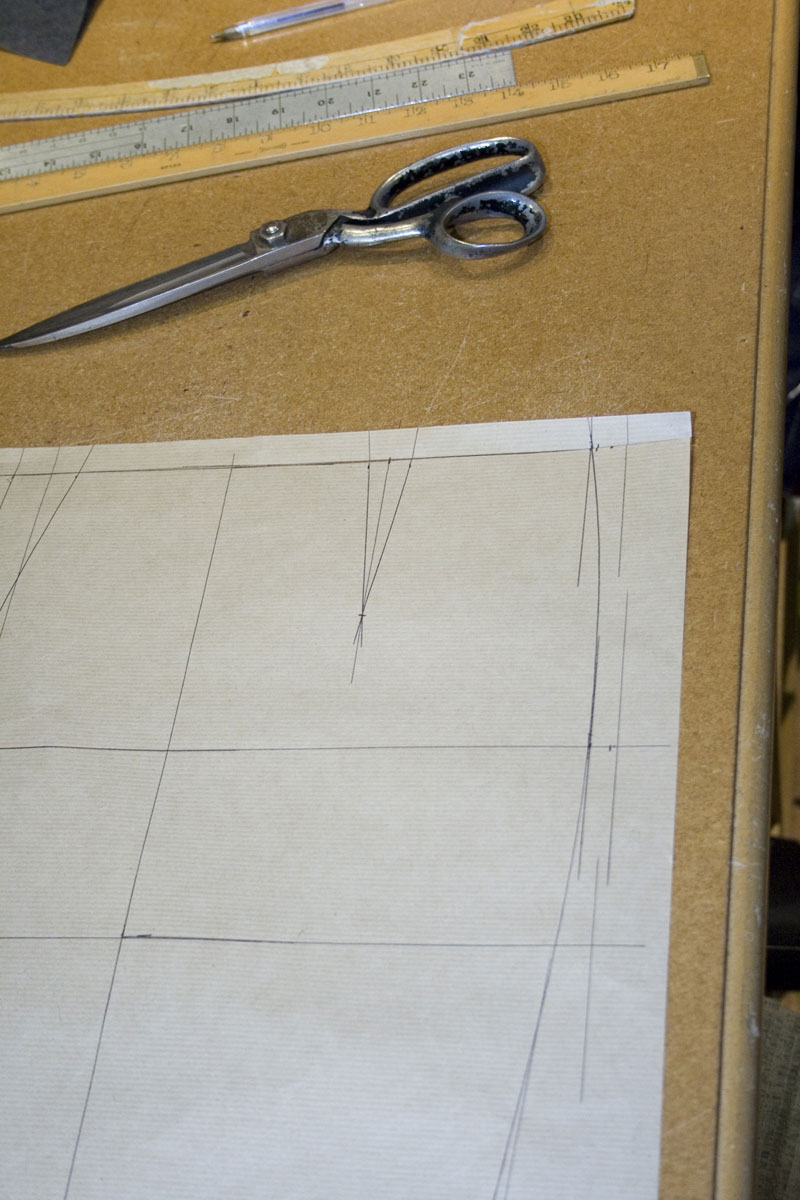
First I saw the patterns being drawn. Picture 1 shows the pattern for the front part of the trousers, which has just been drawn out. The three length points are marked first – the bottom of the trouser, the knee, and the top of the inside leg. The width of each point is then marked off and joined together by ruler.
bbp1
The three lines you can see in this photo are the inside leg, the hip and the waist, the lines between which are curved. The triangle in the centre of the picture is a front dart. Given my waist, two darts were needed (more or less can be used depending on one’s measurements) and the house style at Graham Browne is to have one in the front, here, and another in the back. Some tailors put two in the back but the guys here feel one dart in the front of the trouser adds a little needed room across the pocket – especially if it is a slant pocket. If there was no dart in the front, the curve to the waist (top right) would have to be more acute.
The back of the trousers is also 1¾ inches higher than the front. This varies quite a bit from tailor to tailor. The guys at Graham Browne say they have worked a lot on their trouser system in recent years, but wouldn’t give away any more than this.
The second picture shows the patterns being cut out – that’s the front and back of the jacket, right and left. The greatest skill is in drawing up and cutting these patterns correctly, rather than tracing them onto the cloth with chalk – even though this often gets greater attention.
bbp2
In the next picture Russell is tracing the pattern of the sleeve onto the paper below, using a spiked wheel. Russell is fastidious about his sleeves – indeed just one mention of them launches an explanation of how rounded the shoulder must work here, and the fact that some other tailors fall down by leaving the sleeves up to the tailor, rather than the cutter.
bbp3
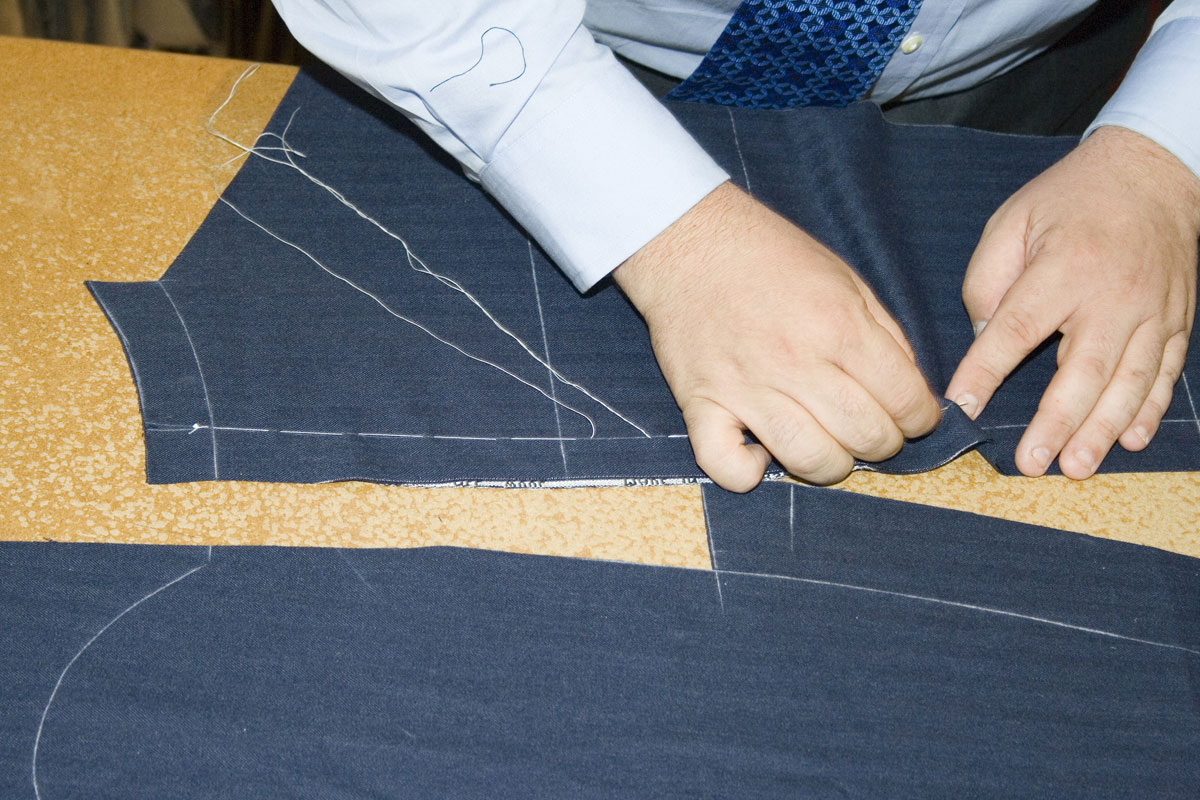
And picture four, below, shows how that rounded shape is taken on – the larger piece is the outside of the sleeve and the front piece is the inside. The two shapes need to flow smoothly together, rather than chop squarishly from one shape to another.
bbp4
Next the patterns are traced with chalk onto the cloth. I love the fact that the best way to rub out a mistake is just to hit the cloth with an open hand – the chalk dust flies off. If it were rubbed it would just work further into the material.
bbp5
The penultimate photo shows the full suit chalked up on the cloth. Notice that there is only one half of each section here – one side of the front of the jacket, one side of the back and one sleeve. The cloth is doubled up and both parts cut together.
bbp6
Finally, the two halves of the cloth are sewn together with a mark stitch to indicate where the outside edge of the jacket will be – the remainder of the cloth being the inlay inside the chest or sleeve. This is a loose stitch that is immediately ripped apart, but leaves knots of thread to indicate that outside edge. It seems like a tiresome process just to mark an edge, but such is the tradition of bespoke.
bbp7
First fitting later in the week.

Alden new style - brown Horween chromexcel leisure handsewn loafer